
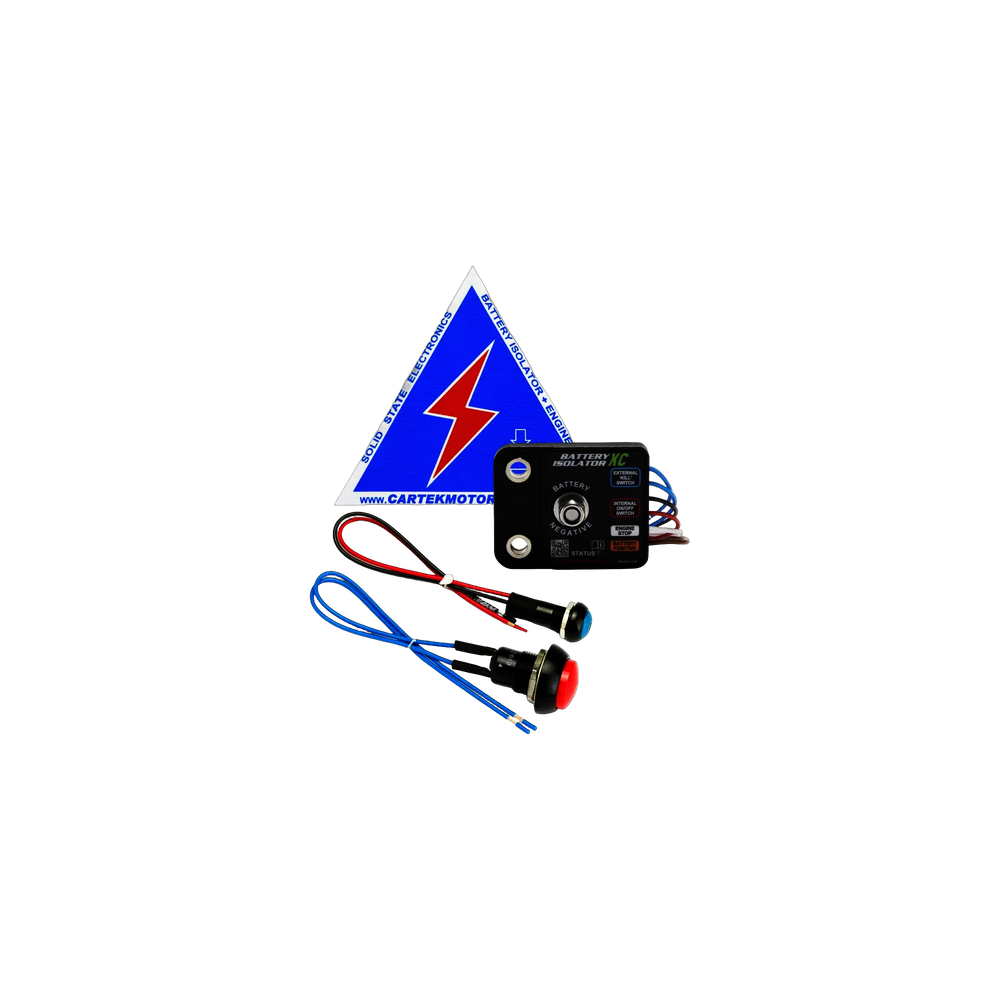
A battery isolator is not a glamorous part, but it is one of the most important safety components on a race car.
Its job is simple: isolate the battery and stop the engine when required. In practice, the right choice depends on the car's electrical system, the regulations, the installation and whether you are replacing an old mechanical master switch or building a modern electronics package.
This guide gives you the simple buying view.
What does a battery isolator do?
A motorsport battery isolator is designed to cut electrical power and stop the engine safely.
That matters in an accident, during recovery, or any time the car needs to be made safe quickly.
Cartek describes its battery isolators as systems that use an internal switch for the driver and an external switch for safety personnel, with the external switch used to turn the isolator off. Cartek also explains that its products are built around motorsport safety requirements, but championship rules should still be checked before buying.
Mechanical vs solid-state
Traditional master switches are mechanical. They physically switch the circuit.
Solid-state isolators use electronic switching. The attraction is usually size, weight, reliability and resistance to the kind of vibration, water and dirt that motorsport throws at components.
Cartek's XR instructions describe the XR as a fully electronic master/kill switch system for race car applications, with no moving parts and resistance to shock, vibration, water and dirt. The same instructions list technical details including 60mm × 45mm size, 70g weight, 7v to 18v operating voltage and a 25mA on-state current draw.
Where the XR fits
The Cartek Battery Isolator XR is aimed at race cars using motorsport ECUs or PDMs. Cartek describes the XR as a smaller version of the GT, using a 5-pin Binder connector and a low-current engine kill signal suited to cars fitted with motorsport ECUs or PDMs.
In plain English, XR is the one you look at when the car has a more modern electronics setup and you want a compact solid-state isolator.
Where an M1-style isolator fits
For many buyers, the question is not just "M1 or XR?" It is "what does my car actually need?"
An older or simpler race car may have a more basic electrical system. A modern build with an ECU, PDM and more complex electronics may need a different isolation method.
Before choosing, check:
- Battery type and location
- Alternator setup
- ECU/PDM setup
- Whether the car needs a low-current kill signal
- Existing wiring layout
- Motorsport regulation wording
- Whether you are replacing an old mechanical switch
- Whether your championship has specific master switch requirements
Do not choose only on price
Battery isolators are safety parts. The cheaper option is not automatically wrong, but the correct option is the one that fits the car and complies with the rules.
Ask:
- Is this for a new build or replacement?
- Is the car using a motorsport ECU?
- Does it have a PDM?
- Is the wiring already built around a specific isolator type?
- Does the championship require a specific style of master switch?
- Does the external switch need to be accessible to marshals?
Regulation reminder
Cartek states that the FIA does not have an approval procedure for master switches, while many FIA race and rally championships require a spark-proof master switch to isolate the battery and stop the engine. That means the important step is checking the exact championship wording rather than looking for a universal "FIA approved" label.
Final advice
If the car has a modern motorsport electronics package, the XR is often the type of isolator people look at first.
If the car is older, simpler or already wired for a different isolator setup, check before ordering.
For safety parts, the right answer is not always the one with the best product title. It is the one that suits the car, the wiring and the regulations.
View Cartek battery isolators or contact VMEP with your car, ECU/PDM setup and championship before ordering.