
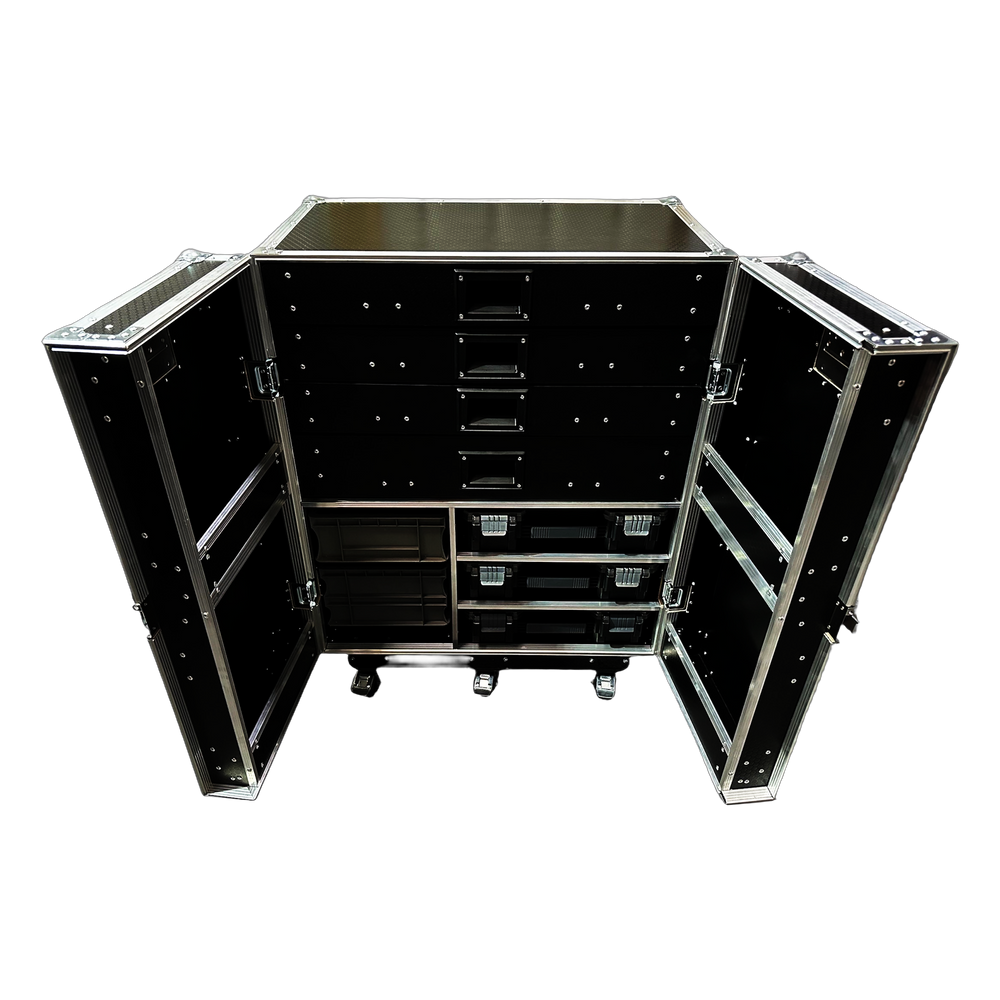
To order custom motorsport equipment made to your specification, send one email saying what it has to carry or do, its dimensions and weight, how it travels and the date you need it in hand. At VMEP that brief gets a firm price and a build window back within 1 working day, you sign off the specification, and the equipment is built in our own workshop in Bidford-on-Avon in 3 to 14 days from that sign-off.
That is the same process for everything we make to order: flight cases, pit perches, pit walling, hospitality units, set-up equipment, foam inserts and one-off components. A normal one-off case lands between £650 and £1,750 ex VAT, pit perches run £6,600 to £7,645, and delivery is charged by weight and destination on top. You do not need drawings. A photograph with a tape measure in shot is often enough to start, and if you do have CAD we take STEP, IGES, DXF, DWG, STL or PDF.
What are the steps from brief to delivery?
- Send the brief. One email, or the quote form, with as much of the checklist below as you have. Drawings and photos go through the file upload.
- We scope and quote, within 1 working day. You get a firm price and a build window in writing. Anything we do not make ourselves, such as screens, fridges, unusual castors or embroidered covers, is quoted separately and stated on the quote before you commit.
- You sign off the specification. This is when the lead time clock starts, not at first enquiry. Deposit and payment terms for bespoke work are set out in the written quote.
- We build it. 3D CAD, CNC routing, fabrication, fibre laser marking and assembly all happen at Unit 20, Bidavon Industrial Estate, so there is no subcontractor queue in the middle of the job.
- Delivery. Tracked UK delivery. Delivery is charged by weight band and destination, with UK, Europe and international zones, and the rates are on the shipping policy.
What is going inside?
Start with the item or items the equipment has to carry, hold or work around. Tell us:
- Product name or equipment type, with make and model if relevant
- Quantity
- Whether it is fragile, or has sharp edges
- Whether it is oily, hot, dirty or awkward to lift
- Whether it needs to stay upright
Typical contents: an engine or gearbox, a tool chest, brake discs and pads, data station equipment, fuel containers, air jack stands, corner weight scales, driver helmets, workshop tooling. The more specific you are, the better.
How do I specify the dimensions?
Dimensions matter more than anything. Send:
- Length, width and height of what is going in
- Any awkward protrusions, and any handles, plugs or fittings that need clearance
- Whether the dimensions are exact or approximate
- Any external size limit, such as a truck aperture, a trailer door or a shelf it has to slide under
If possible, send a photo with a tape measure next to the item. That is often more useful than a long email. If you have a CAD or technical drawing, send that too. Two examples for scale: the VME-Box47 engine transport case is 800 x 800 x 950mm internally, and the VME-Box46 gearbox carry case is 504 x 504 x 404mm. Either end of that range is normal work.
How heavy is it?
Weight changes the build. A light display item and a heavy gearbox do not need the same case. Tell us:
- Weight of the item, and the total loaded weight if carrying several
- Whether it will be lifted by one person, two people or machinery
- Whether it needs castors, and whether it will be rolled over rough paddock ground
Heavy contents may need different boards, frames, castors, handles, tie-downs or internal support.
How and where will it be used?
A case that sits in a workshop has a different job from one that spends every weekend in a truck. Tell us where it will live: workshop, race truck, trailer, pit garage, awning, air freight, courier shipping, long-term storage or international travel. Also tell us how often it moves. Once a year is a different build from every round of a championship.
What access, layout and protection do you need?
Think about how you want to use it when it is open. Options include:
- Removable lid, hinged lid or front cover
- Drawers on runners, shelves, dividers and locking compartments
- Routed foam inserts, shadow foam or foam lining
- Tie-down points
- Side tables or a work surface
- Power access, cable ports and ventilation
Then say what the priority is: impact protection, keeping items separated, scratch protection, secure transport, easy loading or team presentation. For fragile or high-value equipment, include photos of the vulnerable points. This is where custom work earns its money. The equipment should not just carry the item. It should make using the item easier.
Does it need branding?
If it has to match your team or business, send logo files, colour preference, and any label, plaque or team name requirements. Logo plates and control labelling are marked in-house on our fibre laser, so branding does not add a third party to the job. Panel finish is a priced option: black or blue hexaboard, blue or red smooth, or Ultra Lightweight where transport weight matters.
How long does made-to-order equipment take?
3 to 14 days from signed-off specification. A straightforward hexaboard storage case is at the short end. A multi-screen pit perch, or a hospitality unit with a fridge, power distribution and drawers on runners, is at the long end, and you are told which before you pay. The days between your first email and an agreed specification are scoping days, not build days. Full detail is on the lead times page.
Always give the actual date you need it in hand, not "as soon as possible". If it is for a race weekend, a test day, a shipment or a truck loading date, say so in the first email. Race calendars do not move, and your real deadline is usually earlier than the event because it has to be in your hands in time to be loaded. If the date is achievable we confirm it in writing with the quote. If it is not, you are told straight away.
How much does made-to-order equipment cost?
A bespoke build lands close to the equivalent catalogue item, because it is made from the same materials on the same machines. Current starting prices, ex VAT: tool box cases from £825, data station cases from £550, hospitality cases from £580, Euro container cases from £545, pit perches £6,600 to £7,645, and pit walling kits from £9,895. Half of our 249 published cases start between £646 and £1,752. Size, internal complexity and bought-in hardware move the number most. The full breakdown is in how much a bespoke motorsport flight case costs.
What is the best format for the brief?
One email with:
- What is going inside
- Dimensions and weight
- Photos, ideally with a tape measure in shot
- How and where it will be used
- Access, layout and protection requirements
- Any branding
- Delivery postcode or country
- The date you need it in hand
That is enough for a proper quote. You do not need to know the construction method. That is our job. You do need to say what it has to carry, where it is going and how it will be used.
Send your brief to VMEP with photos, dimensions and your required date, or see what we build to order.