
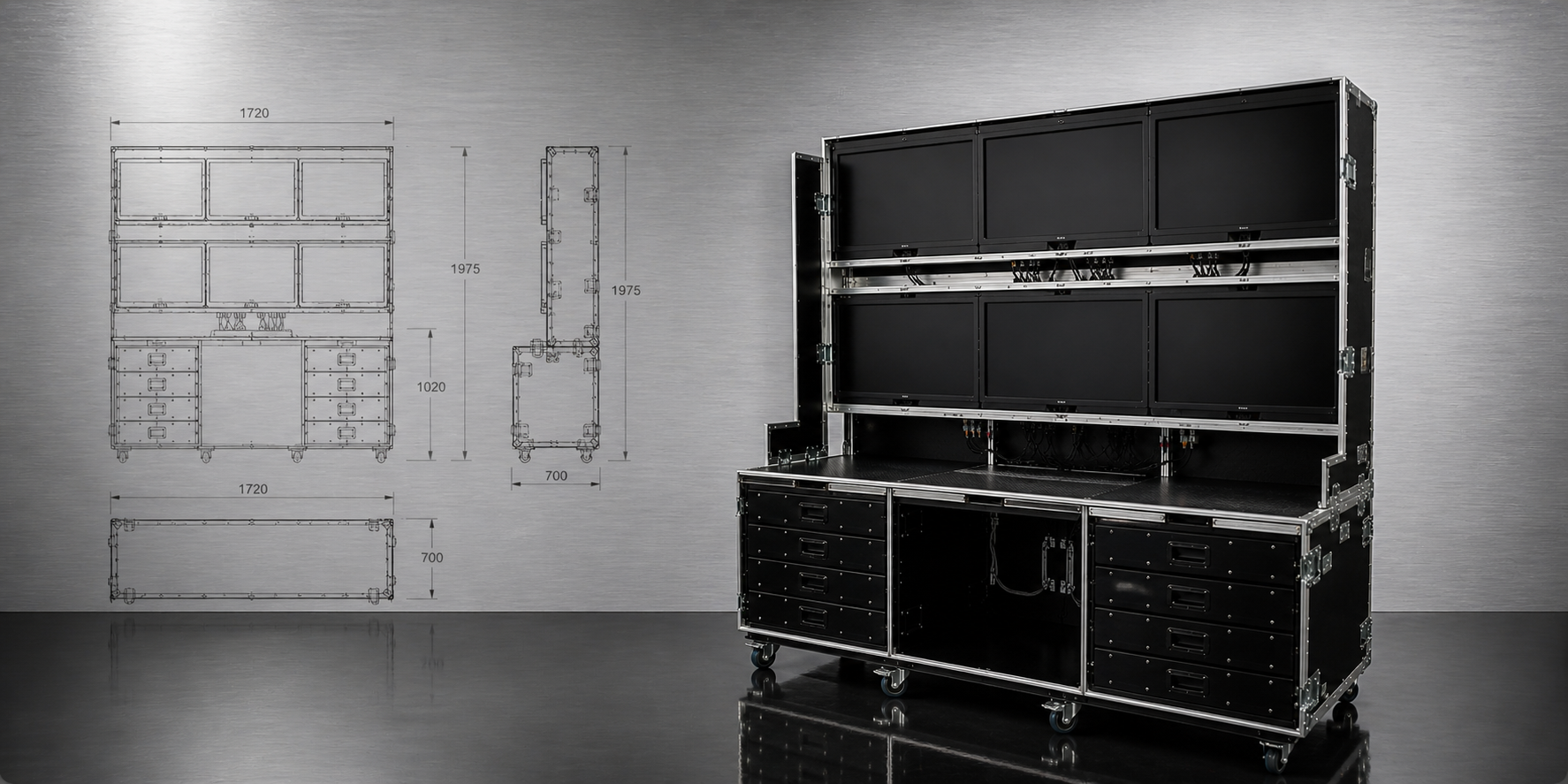
A good pit perch should make race weekends easier, not just make the garage look better.
The right setup gives engineers somewhere to work, keeps screens and data visible, creates a clean team area and packs down properly for transport. The wrong setup takes up too much space, blocks movement in the garage or does not give the team enough usable working area.
This guide explains how to choose a pit perch size without overcomplicating it.
Start with car count
The first question is simple: how many cars are you running?
For a single-car team, a compact pit perch or smaller command unit may be enough. You usually need space for timing, basic data, radio, paperwork and one or two people working from screens.
For a two-car team, you normally need more screen space and a wider working area. You may have more drivers, more engineers and more people needing to see information at the same time.
For three or four-car operations, the perch becomes more than a desk. It becomes the team's control point. At that point, you need to think about screen count, sight lines, power, cable routing, weather protection and whether the whole unit can be moved efficiently.
Think about people, not just cars
A pit perch is not sized only by the number of cars. It is sized by how the team works.
Ask:
- How many people need to sit or stand at the perch?
- How many people need to see the screens?
- Are engineers using laptops?
- Will radios be managed from the perch?
- Will guests, drivers or team managers use the space?
- Is it used for live data, timing, video or hospitality?
A small team with one car but heavy data needs may need more screen space than a casual two-car setup. A larger team may need a wider perch but not necessarily more screens if the garage operation is simple.
Screen count and layout
VMEP has built pit perch units with multiple smart TV screens, HDMI, USB and coax connection points, power integration and flight-case transport. One existing 4 × 24 inch smart TV pit perch disassembles into a flight case and uses a TIG-welded stainless steel tubular side framework, aluminium composite panelling, levelling feet and a waterproof cover option.
That gives a good example of the practical considerations. It is not just "how many screens?" It is also:
- How the screens are protected in transport
- How the frame bolts together
- How power is fed into the unit
- Whether the unit has levelling feet
- Whether the panels can handle paddock use
- How the whole thing packs down
Garage and paddock space
Before choosing a larger perch, check the space you actually have.
Measure:
- Garage width
- Depth available behind the car
- Walkways around the car
- Awning or paddock footprint
- Transport space in truck, trailer or van
- Height restrictions if the perch has a roof or cover
A pit perch that is too large becomes annoying quickly. It slows the team down, blocks access and makes packing up harder.
When to go custom
A custom perch makes sense if:
- You have a fixed truck or trailer layout
- You need a specific screen arrangement
- You want integrated data, radio or power
- You need branding or embroidered covers
- You want it to pack into a specific flight case footprint
- You run the same setup across a full season
If you are running a serious team, custom usually pays for itself in time saved and a cleaner garage setup.
Quick guide
As a simple rule:
1 bay or compact perch - single-car team, smaller garage, basic timing/data.
2 bay setup - one or two cars, more engineer space, better screen visibility.
3 bay setup - multi-car team or a more serious data/radio setup.
4 bay or larger custom setup - larger team, proper command area, more screens, more people, more kit.
What to send VMEP
To quote a pit perch properly, send:
- Number of cars
- Number of screens required
- Approximate garage or awning space
- Transport method
- Desired packed size
- Whether it needs a cover
- Any branding requirements
- Photos of your current setup if available
Final advice
Do not choose the biggest perch just because it looks professional.
Choose the one that fits your race operation, your people, your screen requirements and your transport setup.
View pit equipment or contact VMEP to discuss a custom pit perch.